The Ottomans
The Ottoman Turks, who emerged as the new leaders in the Middle East in the early 14th century, followed the reign of the Seljuk Turks, who had been overrun by the Mongols and had never fully recovered. These new Turks first emerged in the border regions of the Byzantine Empire, and used that position to consistently vie with the Byzantines for territory and power. The founder of the dynasty, Osman, and his successors expanded the empire, seizing considerable holdings in both Europe and Asia, although there were occasional setbacks (the defeat of the Ottoman army in Ankara, in 1402, led to the suicide of the Sultan). By the reigns of Mehmed I and his son, Murad II, the Ottomans were expanding considerably into the Balkans, having defeated the Serbs, Hungarians, and Greeks. These Ottoman rulers were not known for only their military prowess; they also encouraged literature and the arts, and were sponsors of some of the great poets and writers of the age. In 1451, when Mehmed II came to the throne, the Ottomans were masters of two distinctive empires, one in Anatolia and one in Europe, divided by the holdings of Constantinople and the last remnants of the Byzantine Empire. In 1453, after a siege of 7 weeks, the Turks succeeded in taking the city, marking the end of the Byzantine Empire. The last Byzantine emperor died with his troops, and a new era began in Middle Eastern rule.
The victory of Mehmed II earned him the sobriquet of “the Conqueror” and linked together the Ottomans with their European holdings. The remainder of his reign focused on continuing to expand his holdings, both in Asia and in Europe, and consolidating the power of the empire for his successors. The Ottomans adopted the use of firearms much more readily than their other Islamic counterparts, making it easier for them to defeat the Mamluks and other threats to their dominance. The struggle of the Ottomans against the Shahs of Iran was more than just a battle for physical control of the region; it was also a battle between the sects of Islam, as the Shahs favored Shi’ite faith, while the Ottomans saw themselves as the champions of the Sunnis. The Ottomans were not able to destroy the power of the Shahs, although they were able to limit their power. The Ottomans were far more successful against the Mamluks of Egypt, who fell to the Turks in 1517 and saw the destruction of one of the few rivals to Ottoman power. With the defeat of the Mamluks, and the accession of Suleyman the Magnificent (1520-66), the Ottomans reached the apex of their power.
Suleyman’s reign is one during which the Ottomans’ reputation was secured. The new Sultan was known not only as the Magnificent, but also as “the Law-Giver”, in part because he surrounded himself with specialists in Islamic law who helped more clearly define the law of the Ottomans. He also sponsored great building and other civic projects, making Baghdad and Damascus showplaces to demonstrate the power of the Ottomans. Suleyman is also responsible for transforming Constantinople from a Western city to a Muslim city. He also was known for his significant conquests, against both the Persians and the Western powers; it was during his reign that the Ottomans had significant power over the rulers of Hungary, expanded their navy, and dominated the Mediterranean. Unfortunately, the later part of his reign was marked by dissent among his sons, and Suleyman was forced to execute one of his sons for treason in 1554. Suleyman himself died while besieging a Hungarian fortress; from that point forward, the Ottomans began a slow but steady decline. Suleyman’s son, Selim II, earned the sobriquet “the Drunkard” and was the first of the Ottoman rulers who retired almost completely from any kind of actual decision-making. He set the precedent for his successors to ignore ruling and leave it in the hands of their advisors, a model that would be followed for the next three centuries. In addition to the incompetence of the Sultan, the army corps began to decline as well; the traditional feudal structure began to crumble, and with that, the power of the cavalry (always the purview of the nobility and the gentry) began to fall apart. The Sultans were forced to rely on a larger standing army, which meant more outlay of money by the state, forcing an increase of taxes and seizures of lands. None of these developments would have spelled the end of the Ottomans, but the combination would prove to have deadly consequences.
Part of the reason for the decline was also the increasing power of the Shahs of Iran. Unlike the Mamluks, who had been essentially destroyed by the Turks, the Persian empire had never completely been cowed by the Ottomans. They also, like their Turk counterparts, were willing to take up the use of firearms. With the defeat of the Mongols in the east by the rulers of Russia (the rulers stopped paying tribute in 1480, and defeated the remainders of the Golden Horde under the rule of Ivan the Terrible), the Persians and the Turks faced a new enemy in the east. The Russian rulers, who adopted the title of “tsar” (the Russian derivation of “Caesar”) under the reign of Ivan III, sought to expand their holdings to the south, ideally seeking a warm water port (the most desirable being those on the Black Sea). The dream of all of the Russian tsars from the time of Aleksei Mikhailovich (r. 1645-1676) forward would be control of Constantinople and therefore access to not only the Black Sea but also the Dardanelles. This desire would remain at the top of the list for all Russian rulers (even the Bolsheviks sought access to Constantinople) to the modern day.
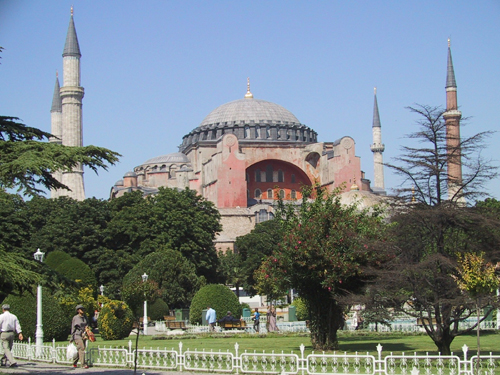
[*These two photos, taken by my former student Adam Schneider, show the inside and outside of the Hagia Sophia in Constantinople (now Istanbul). As you can see from both pictures, the basilica was altered by the Ottoman Turks: the minarets were added after the conquest, and attempts were made to remove the human images from inside the church. Used with permission from Adam Schneider, currently a student at the University of Colorado, Boulder*] |
|
|

|
|