Monday – March 16, 1998 – Rabat
 After a lavish buffet breakfast, we drive to the Offices of the Association Ribat Al Fath
(literally, Fortress of Faith) for the first of our three lectures on this tour. The speaker,
Dr. Kreim, was delayed on government business, so we walked over to the Foundation Hassan II
for the Handicapped, which is housed on the grounds. We visit several classes aimed at developing
life skills, ranging from handicrafts to computer literacy. Since our schedule must be
rearranged,
our group decides to drive to the Chellah Necropolis. This is an ancient site encompassing Roman
ruins, sultans' tombs, a medersa (a school from 1248 to 1554) with remnants of lovely tilework on
arches and doorways,
After a lavish buffet breakfast, we drive to the Offices of the Association Ribat Al Fath
(literally, Fortress of Faith) for the first of our three lectures on this tour. The speaker,
Dr. Kreim, was delayed on government business, so we walked over to the Foundation Hassan II
for the Handicapped, which is housed on the grounds. We visit several classes aimed at developing
life skills, ranging from handicrafts to computer literacy. Since our schedule must be
rearranged,
our group decides to drive to the Chellah Necropolis. This is an ancient site encompassing Roman
ruins, sultans' tombs, a medersa (a school from 1248 to 1554) with remnants of lovely tilework on
arches and doorways,
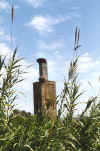 and the ruins of a mosque, the minaret of which is topped by
nesting storks. In fact, the entire structure, as well as most of the surrounding trees, has become a haven for
storks. We see the tombs of the Black Sultan, Abou Hassan, and his wife. Leo Africanus,
the Moorish historian who wrote an eyewitness description of Africa "..and of the Notable Things
Therein Contained", counted 32 Merenid graves at this site in the year 1500. The Merenids were one
of the powerful ruling dynasties of ancient Morocco. At this site, there is also a pond, which is
inhabited by a number of sacred black
eels. Infertile women feed the creatures hard-boiled eggs
daily. Legend has it that the eels, if pleased by the offerings, will grant these women the ability
to bear children. I guess it's worth a try!
and the ruins of a mosque, the minaret of which is topped by
nesting storks. In fact, the entire structure, as well as most of the surrounding trees, has become a haven for
storks. We see the tombs of the Black Sultan, Abou Hassan, and his wife. Leo Africanus,
the Moorish historian who wrote an eyewitness description of Africa "..and of the Notable Things
Therein Contained", counted 32 Merenid graves at this site in the year 1500. The Merenids were one
of the powerful ruling dynasties of ancient Morocco. At this site, there is also a pond, which is
inhabited by a number of sacred black
eels. Infertile women feed the creatures hard-boiled eggs
daily. Legend has it that the eels, if pleased by the offerings, will grant these women the ability
to bear children. I guess it's worth a try!
Today's lunch is at a very nice ocean-side
restaurant. Unfortunately, they only serve seafood.
Since this is one gastronomic area where I cannot indulge, I spend the next hour looking out the
windows and reminding myself that occasional fasting is good for the sole (sic)! I want to mention
here, that during the morning and lunch hours, Phil had gone back to Casablanca by taxi to retrieve
the two errant suitcases. He rejoins us now on the bus ride back to the Association Ribat Al
Fath.
We will be attending the previously postponed lecture on Moroccan Traditions and Islam. Dr. Kreim
presents some intricate and fascinating theories, linking Christianity, Judaism and Islam. The
similarities and differences were compared and contrasted and his talk provided much to think about.
He is a very dynamic speaker, and I can understand his value as an advisor and attaché to King
Hassan II.
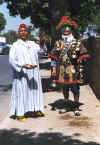 We are off again, this time to the Mausoleum of Mohammed V and the Hassan Tower (the word Hassan means "goodness"). At the entrance, we encounter a colorful water seller and
Martha snaps a photo, giving him the inevitable 10-dirham "thank you". The Mausoleum
we are
visiting is a tribute to Mohammed V, the king who, in 1956, achieved Moroccan independence.
It was built between 1961 and 1969. The style is typical of Moroccan architecture with a
pyramidal
roof of distinctive green tiles. In 1971, 10 years after his death, the body of the king was moved
to this site. In 1983, his youngest son,
We are off again, this time to the Mausoleum of Mohammed V and the Hassan Tower (the word Hassan means "goodness"). At the entrance, we encounter a colorful water seller and
Martha snaps a photo, giving him the inevitable 10-dirham "thank you". The Mausoleum
we are
visiting is a tribute to Mohammed V, the king who, in 1956, achieved Moroccan independence.
It was built between 1961 and 1969. The style is typical of Moroccan architecture with a
pyramidal
roof of distinctive green tiles. In 1971, 10 years after his death, the body of the king was moved
to this site. In 1983, his youngest son,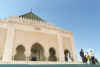 Prince Moulay Abdullah, was buried
here. Across from the
mausoleum stands the Hassan Tower. This is the minaret of the mosque begun in 1195 but never
completed. The 312 marble columns for the huge mosque are now all that remain after the 1755
earthquake that destroyed Lisbon. As we leave the compound, we wave goodbye to the
mounted guards
at the gate.
Prince Moulay Abdullah, was buried
here. Across from the
mausoleum stands the Hassan Tower. This is the minaret of the mosque begun in 1195 but never
completed. The 312 marble columns for the huge mosque are now all that remain after the 1755
earthquake that destroyed Lisbon. As we leave the compound, we wave goodbye to the
mounted guards
at the gate.
We drive to the Royal Palace (there's one in every major city) but cannot go inside because
the royal family is in residence. We take some photos of the soldiers standing outside while Larbi
answers questions about the palace. Afterwards, we walk along the parade grounds to the Ahl al-Fas
(People of Fès) Mosque or Mosque El
Faeh. As Larbi leads us to the back of the structure, we see
what appear to be public restrooms. We are a little startled when he insists that all of us follow
him into the room obviously marked "men", but we find the area unoccupied. Larbi has brought us
here to demonstrate the cleansing ritual that all Muslims perform before praying. He proceeds to
wash his hands, arms, feet, head and neck in running water (washing of the head and neck include
cleaning the eyes, ears, nose and mouth). He tells us that if there is no water available, clean
sand will suffice; where there is no sand, they just go through the motions of washing.
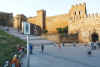 The next stop is the
Bab Oudaia, the gate to the original fortress (ribat) that gave the
Moroccan capital its name. The oldest mosque in Rabat, the Jamaa El Atio, can be found inside
these walls. We enter the 12th century fortress at the highest point and from there, standing on
the semaphore terrace, we looked across the Bou Regreg estuary to see the ancient port city of Salé.
Larbi has decided to begin our walk at the top of the kasbah and lead us downhill through the
narrow winding main street, Rue
Jamaa. We pass many whitewashed houses and
The next stop is the
Bab Oudaia, the gate to the original fortress (ribat) that gave the
Moroccan capital its name. The oldest mosque in Rabat, the Jamaa El Atio, can be found inside
these walls. We enter the 12th century fortress at the highest point and from there, standing on
the semaphore terrace, we looked across the Bou Regreg estuary to see the ancient port city of Salé.
Larbi has decided to begin our walk at the top of the kasbah and lead us downhill through the
narrow winding main street, Rue
Jamaa. We pass many whitewashed houses and shops, and Martha cannot
resist taking photos of the beautifully decorated doorways, especially the Dar Baraka (House of
Good Fortune). The street ended at the Café Maure. A door from its terrace leads into the famed
Andalusian Gardens, but their gates were just closing and we were disappointed that we could not
enter. We leave the kasbah through its principal gateway the Almohad Gate, a monumental arch
consisting of two large wooden doors flanked by massive towers.
shops, and Martha cannot
resist taking photos of the beautifully decorated doorways, especially the Dar Baraka (House of
Good Fortune). The street ended at the Café Maure. A door from its terrace leads into the famed
Andalusian Gardens, but their gates were just closing and we were disappointed that we could not
enter. We leave the kasbah through its principal gateway the Almohad Gate, a monumental arch
consisting of two large wooden doors flanked by massive towers.
Our long day of touring eventually draws to an end. We take a leisurely
stroll in the Hilton gardens before dinner. Afterwards, we
retire to our rooms, to dream of sultans, storks, sacred eels and sellers of water.